Futsal Court Construction & Turf Installation
A court that fills up every evening without being asked.
sportsOS builds futsal courts from the base up: sub-base and shock pad, turf laid and seamed, goals, fencing, lighting and line marking, delivered as one order in 5 to 10 days. Futsal is part of our wider sports infrastructure projects for campuses, and the court is ready for a 5-a-side the day after handover.
Turf installation, line marking, and goal assembly completed in sequence
FIFA-recommended dimensions for 5-a-side indoor or outdoor play
Optimal blade length for ball roll, player comfort, and drainage performance
Indoor futsal or outdoor football, built for your space
Both use FIFA-quality artificial turf. The difference is the base construction, pile height, and fencing system matched to the environment.
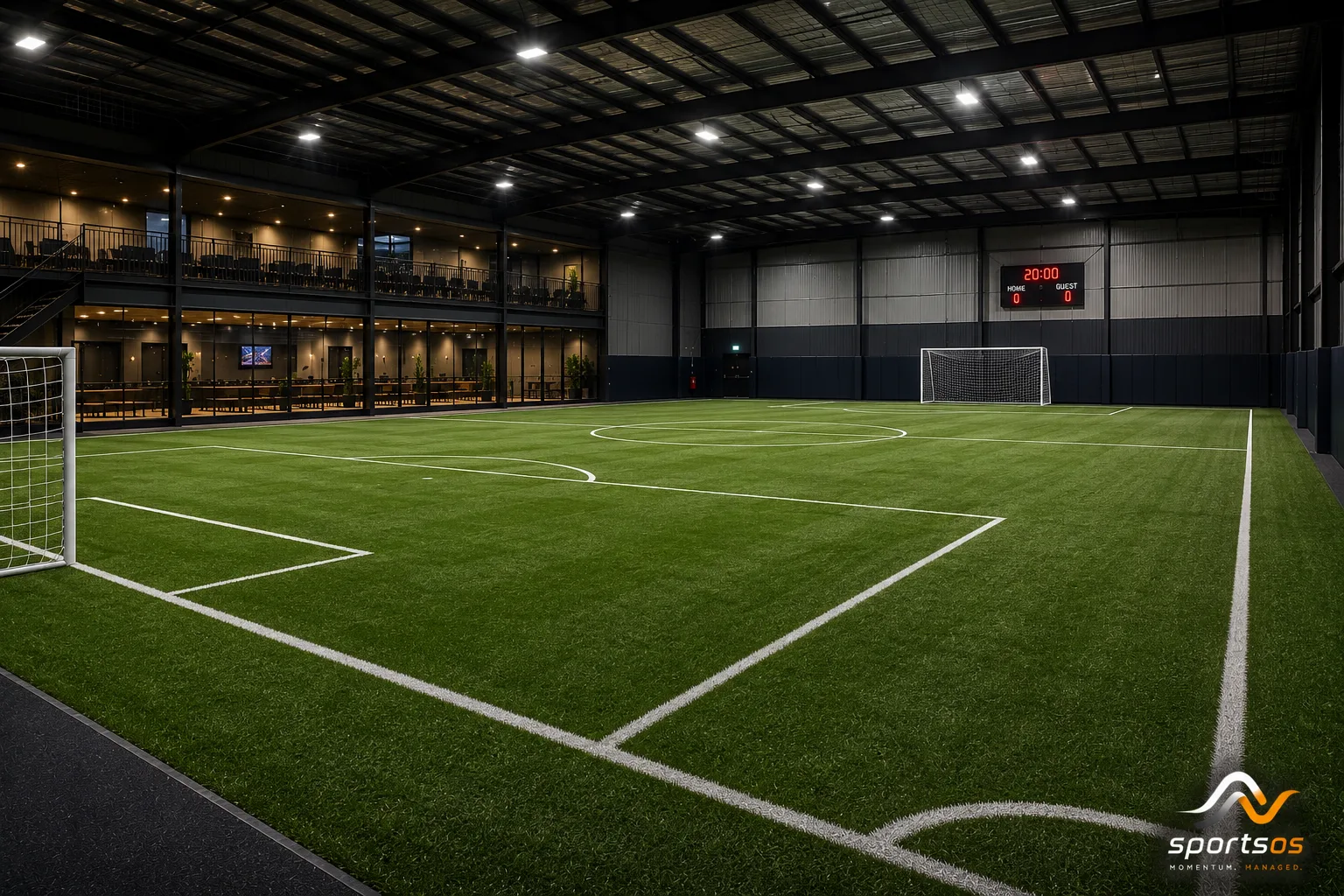
Indoor Futsal Court
20–25 mm low-pile artificial turf on a shock pad base, optimised for the fast, technical play of futsal. Perimeter boarding keeps the ball in play and protects walls. Suitable for year-round daily use, no mud, no maintenance beyond brushing.
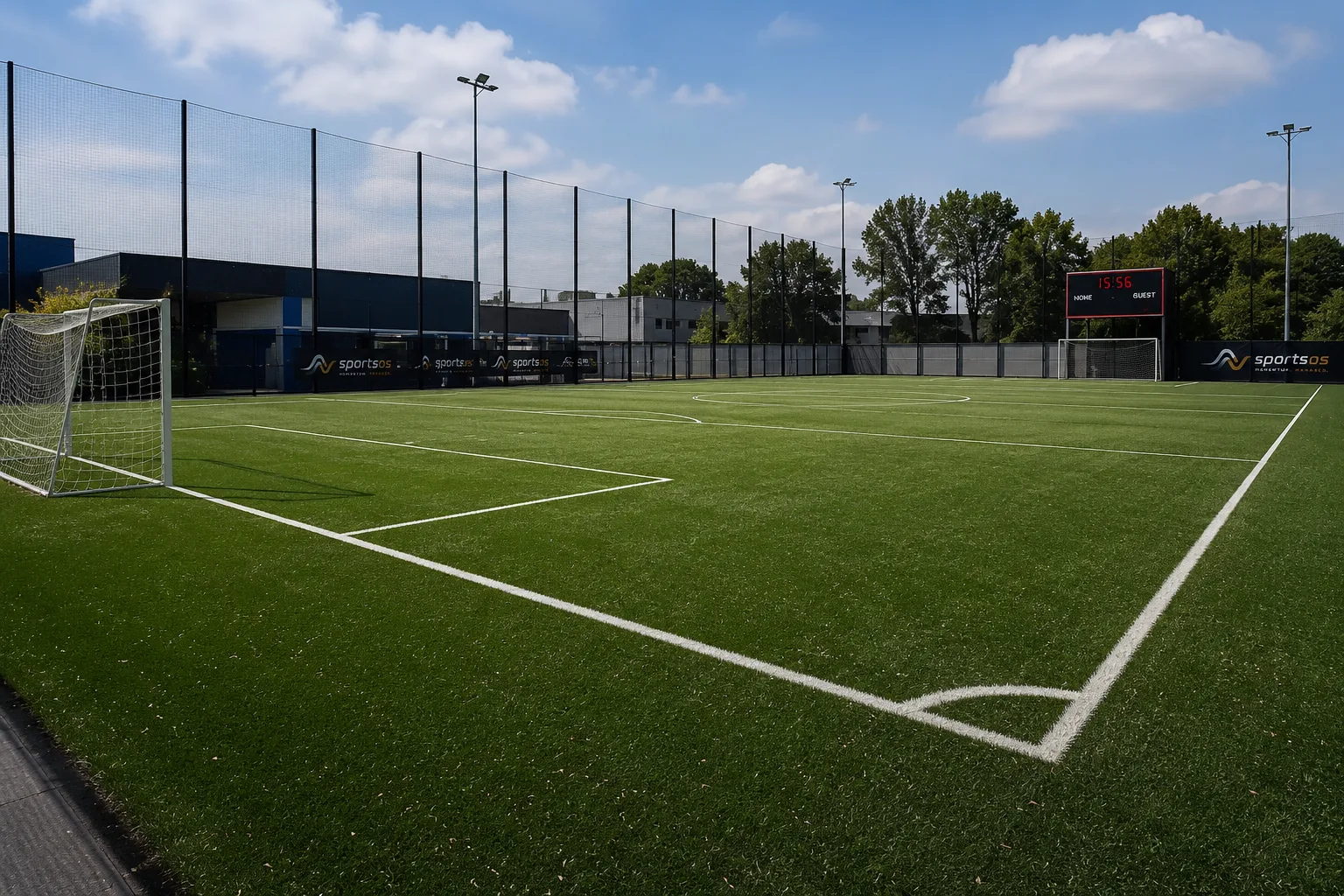
Outdoor Football Court
35–50 mm high-pile artificial turf with silica sand and rubber infill, built to handle sun, rain, and heavy traffic without degrading. Chain-link or welded-mesh fencing around the perimeter, with floodlights for evening sessions.
Turf to goals, one order
Turf, base, fencing, goals, line marking, and lighting in a single GST-compliant proposal. No sub-contractors to manage.
Artificial Turf
FIFA-quality monofilament or fibrillated turf laid on a compacted base with shock pad. Infill brushed and levelled before handover. Consistent surface across the full playing area.
Goals & Nets
Futsal goals (3×2 m) or full-size football goals (7.32×2.44 m) with aluminium or steel frames, ground anchored. Nets included, tensioned, and clipped at handover.
Court Line Marking
Touchlines, goal lines, centre circle, penalty areas, and corner arcs marked using inlaid turf lines or painted marking as per the court type. FIFA-compliant dimensions throughout.
Perimeter Fencing
Chain-link or welded mesh fencing around the court perimeter for outdoor courts. Rebound boarding panels for indoor courts. Keeps play contained and protects surrounding areas.
LED Floodlighting
Pole-mounted or wall-mounted LED floodlights providing uniform illumination across the full court surface for evening play. 200+ lux at field level, enough to play comfortably after dark.
Handover & Care Guide
Walkthrough with facility staff covering turf brushing schedule, infill top-up timeline, goal net inspection, and basic drainage check. Maintenance guide left on-site at handover.
Built to specification
FIFA-recommended dimensions and turf parameters used for every installation. Getting the base and infill right is what separates a court that plays well from one that feels wrong underfoot. For the full marking layout, goal sizes and ceiling clearance, see our futsal court dimensions guide. For budgeting, see the football turf cost guide.
| Parameter | Standard | What it means in practice |
|---|---|---|
| Futsal court size | 40×20 m | FIFA minimum for competitive 5-a-side. Can be reduced for smaller spaces. |
| Football court size | From 60×40 m | 7-a-side or 5-a-side outdoor, depends on available ground area |
| Turf pile (futsal/indoor) | 20–25 mm | Short pile for fast, accurate ball roll, closer to natural grass feel |
| Turf pile (outdoor football) | 35–50 mm | Longer pile absorbs impact, drains rain, and handles heavy use without compacting |
| Shock pad thickness | 10–15 mm | Protects joints on hard base surfaces, required for player comfort and safety |
| Futsal goal size | 3×2 m | FIFA-standard for 5-a-side indoor futsal |
| Football goal size | 7.32×2.44 m | Full-size regulation goal, used for 7-a-side and above |
| Floodlight level | 200+ lux | Minimum for comfortable evening play without shadows or glare |
| Fencing height (outdoor) | 4–6 m | High enough to catch aerial balls and prevent them leaving the court |
| Turf warranty | 8–10 years | Commercial-grade turf with UV-stabilised fibres holds up for a decade of daily use |
Futsal Court (Top View)
From a compact futsal box to a full outdoor ground
Court size and surface spec are matched to your available area and how the space will actually be used.
Mini Futsal Box
A smaller enclosed court for rooftop terraces, basements, or tight indoor spaces. Faster play, high energy, and works brilliantly for campus leagues and lunchtime 3-a-side.
- 20×12 m to 30×16 m
- Low-pile turf on shock pad
- Rebound boarding perimeter
- LED overhead or wall-mounted lighting
Full Futsal Court
The most common campus setup. Regulation 40×20 m FIFA-spec futsal court, suitable for 5-a-side leagues, tournaments, and daily use by large employee groups.
- 40×20 m FIFA standard
- 20–25 mm turf, shock pad base
- Futsal goals (3×2 m) with nets
- Full line marking, perimeter boarding
Outdoor Football Ground
An open-air football ground for campuses with large outdoor areas. 7-a-side or larger, with full-size goals, high perimeter fencing, and LED floodlights for evening matches.
- 60×40 m and above
- 40–50 mm high-pile turf + infill
- Full-size goals with net system
- 4–6 m perimeter fencing, floodlights
Site visit to first kick-off in 4 steps
Site Assessment
We survey the available ground or indoor area, check the base surface condition, drainage (outdoor), and structural load (rooftop or indoor), and confirm what court size and spec is viable.
Design & Quote
Court dimensions, turf spec, fencing type, goal size, and lighting layout presented in a full proposal with material breakdown. Approved before any work begins.
Installation
Base preparation first, then shock pad, then turf laid and seamed, then infill brushed in, then fencing, goals, and lighting. Typically 5–10 days for a standard futsal court.
Handover
Walkthrough covering turf brushing, infill inspection, goal net tensioning, and drainage check. Maintenance schedule and service contact left on-site. If you would rather not run it yourself, it can become one of our managed sports facilities. Ongoing upkeep can move straight into futsal turf maintenance under an AMC.
Common questions
A FIFA regulation futsal court is 40 m × 20 m, which is the standard used for competitive and league play. Adding the required one to two metres of run-off and fencing clearance on all sides brings the total required footprint to approximately 44 m × 24 m. However, many excellent corporate futsal courts are installed at smaller dimensions: a 30 m × 16 m configuration is very common in corporate settings and still produces a high-energy, technically sound game. Even a 25 m × 14 m layout works well for informal 4v4 or 5v5 play. The most important factor is that the court width stays above 14 m, below this, the game becomes too narrow to play with proper structure. sportsOS will assess your available area during the site visit and propose the largest viable court size that fits cleanly within your footprint. We will not recommend squeezing a court into space that is genuinely too small to deliver a good playing experience.
Yes, rooftop and terrace futsal courts are among the most popular installations sportsOS completes for corporate campuses, making excellent use of underutilised outdoor space. A rooftop installation requires a structural load verification before work begins: the combined weight of the turf, rubber or sand infill, shock pad underlayer, goals, fencing, and players in motion adds up significantly, typically 35–60 kg per square metre depending on specification. The building's structural engineer must confirm the rooftop slab can handle this load. A continuous waterproof membrane layer must be installed between the roof slab and the shock pad to protect the building's waterproofing integrity, this is a non-negotiable requirement. An adequate drainage system (either existing or newly installed) is required to clear rainfall quickly without ponding, which damages turf and creates a safety hazard. sportsOS coordinates structural and civil requirements during the site assessment phase and flags any prerequisites that must be completed before installation begins. We have completed over 40 rooftop installations across corporate campuses in Bengaluru.
The core difference is pile height and infill specification, which together determine ball behaviour, player comfort, and surface durability. Futsal turf uses a 20–25 mm pile (shorter, denser fibres with minimal infill), producing a firm, fast playing surface that delivers the precise ball control, accurate passing, and quick direction changes that futsal demands as a sport. Football turf uses a 35–50 mm pile with combined sand and rubber crumb infill, which simulates the depth and cushioning of natural grass, absorbs impact from tackles and falls, and provides the give needed for outdoor full-contact play. Using football-specification turf for a futsal court creates problems: the higher pile causes inconsistent ball roll and reduces the quick passing game that defines futsal. Using futsal turf outdoors without adequate infill causes fibres to degrade rapidly under UV radiation and rain. sportsOS specifies the correct turf grade for each installation, futsal courts and football pitches are never specified with the same product.
Artificial turf requires significantly less maintenance than natural grass but needs consistent, structured care to maintain playing quality and extend its lifespan. The weekly routine is brushing, using a stiff-bristled brush or a power brush attachment to restore fibres to an upright position and redistribute infill material that has been displaced by play. Without weekly brushing, fibres mat down in high-traffic areas such as the centre circle and goal mouths, creating inconsistent playing surfaces. Infill levels (rubber crumb and sand), compact with use over time and need topping up once or twice a year depending on play intensity. Annual inspections should cover seam integrity, perimeter fixing tension, and drainage outlet clearance. A blocked drain is the most common cause of turf damage on rooftop installations. This maintenance workload is entirely manageable by your facilities team with a standard brush and basic equipment. sportsOS provides a full annual turf maintenance contract that covers all of the above as scheduled visits, including infill top-up and seam inspection.
Artificial turf is sport-specific in its best applications and does not perform well as a substitute for hard-court sports. Basketball requires a consistent, predictable ball rebound from the playing surface, artificial turf fibres produce irregular bounce that makes dribbling impractical. Tennis requires an ITF-rated hard surface for consistent ball speed and bounce characteristics, artificial turf does not meet this standard. These two sports should be on hard surfaces, not turf. Futsal turf can, however, accommodate additional line markings for handball and volleyball if the court dimensions overlap, these sports have similar ball dynamics to futsal on turf and work well in that setting. If your goal is a single surface that supports basketball, tennis, futsal, and volleyball in the same space, a polyurethane sport surface (also known as an acrylic hard court) is the correct specification. sportsOS designs and installs PU hard courts as well as artificial turf, and can present both options side-by-side so you can choose based on your sport mix and budget requirements.
Ready to build a court your campus will actually play on?
Share your available area and we'll visit, assess, and have a full court proposal back within 48 hours.
Futsal and football guides
- Futsal court dimensions, official FIFA size, markings and clearance
- Sports flooring compared, PU, acrylic, vinyl and wood
- Campus space planning, how much space each sport needs
- Turnkey sports projects
- 5-a-side pitch size, common dimensions and formats
- Football turf, pile height, infill and base