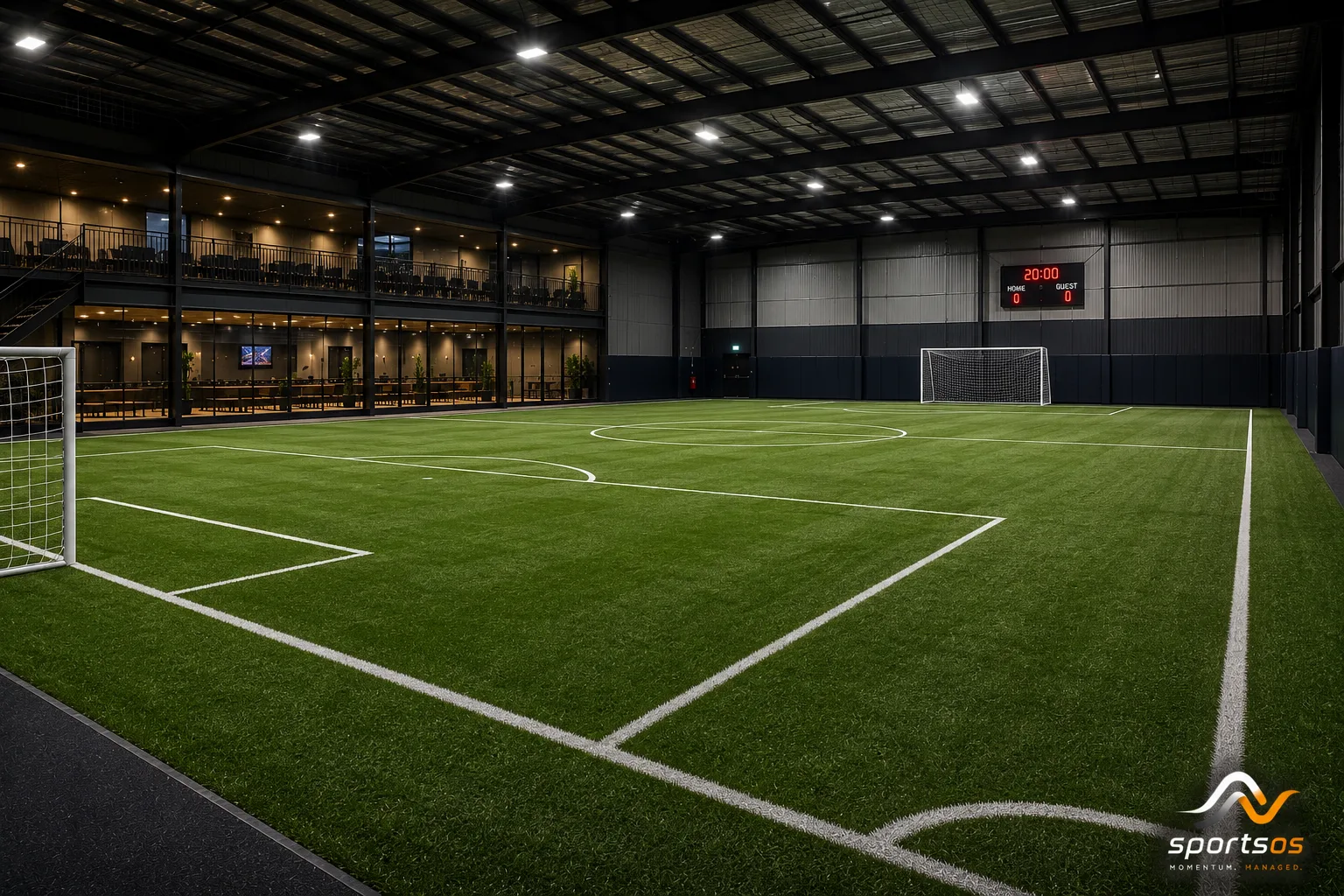
A standard futsal court measures 40 m long by 20 m wide, which is 131 ft by 66 ft. That is the size FIFA recommends for competition and the one most people mean by "full size".
FIFA's Futsal Laws permit a range, not a single number. For domestic play the court may be 25 to 42 m long and 16 to 25 m wide. International fixtures narrow that to 38 to 42 m long and 20 to 25 m wide.
Full futsal court dimensions, in metres and feet
Every measurement below comes from the FIFA Futsal Laws of the Game. Imperial conversions are rounded to the nearest sensible working figure, which is what a contractor will mark out on site.
| Element | Metric | Imperial | Notes |
|---|---|---|---|
| Standard court size | 40 × 20 m | 131 × 66 ft | FIFA recommended competition size |
| Length, domestic range | 25 to 42 m | 82 to 138 ft | Touch line, always longer than the goal line |
| Width, domestic range | 16 to 25 m | 52.5 to 82 ft | Goal line |
| Length, international | 38 to 42 m | 125 to 138 ft | Required for sanctioned international play |
| Width, international | 20 to 25 m | 66 to 82 ft | Required for sanctioned international play |
| Goal size | 3 × 2 m | 9.8 × 6.6 ft | Width between posts, height to underside of bar |
| Penalty area radius | 6 m | 19.7 ft | Quarter circle from the outside of each post |
| Penalty mark | 6 m | 19.7 ft | From the midpoint between the posts |
| Second penalty mark | 10 m | 32.8 ft | Used for accumulated fouls |
| Centre circle radius | 3 m | 9.8 ft | Measured from the centre mark |
| Corner arc radius | 25 cm | 9.8 in | At each of the four corners |
| Substitution zone | 5 m | 16.4 ft | In front of each team's bench |
| Line width | 8 cm | 3.1 in | All markings, uniform width |
| Minimum ceiling height | 4 m | 13.1 ft | Laws minimum. Competition venues build higher |
Futsal court area in square feet
Area is usually the number that matters when someone is checking whether a site will take a court at all.
| Court size | Square metres | Square feet | Typical use |
|---|---|---|---|
| 40 × 20 m | 800 m² | 8,611 sq ft | Full competition court |
| 30 × 16 m | 480 m² | 5,167 sq ft | Common corporate campus size |
| 25 × 16 m | 400 m² | 4,306 sq ft | Smallest court the Laws allow |
Most corporate campuses in India do not have 8,611 sq ft of clear flat space sitting spare, which is why the 30 by 16 m court is far more common than the full 40 by 20. It still plays properly as 5-a-side and it fits on a footprint many campuses already have, often a rooftop or a disused parking deck.
A futsal court and a 5-a-side turf box are not the same thing
This trips up more enquiries than any other point, so it is worth being precise. Futsal under FIFA Laws is played indoors on a hard, flat surface, with a low-bounce ball and no walls in play. What most Indian facilities call a 5-a-side box is artificial turf, usually enclosed by netting or rebound boards, and is closer to small-sided football than to futsal.
The dimensions overlap, which is why the terms get mixed. If somebody is searching for a 5-a-side pitch size they usually want a turf box between 25 and 35 m long, not a marked futsal court. Both are legitimate builds. They need different surfaces, different fencing and different budgets, so it is worth settling which one is actually wanted before a quote is drawn up.
How much total space you need, not just the playing area
The court dimensions are the playing surface only. A buildable footprint needs run-off on all four sides, room for goals to sit back from the goal line, and clearance overhead.
As a planning figure, allow at least 1 m of run-off on each side and 2 m behind each goal line, which puts a 30 by 16 m court on a footprint closer to 34 by 18 m. Ceiling height is the constraint that most often kills an indoor site late in the process. The Laws set 4 m as the minimum, but a ball struck properly will find a 4 m ceiling immediately, so anything built for real use should be looking at 6 m or more. Check that measurement before anything else on an indoor site, because it is the one thing that cannot be designed around.
Surfaces, and what each one suits
For true futsal the surface is hard and seamless. PU synthetic and hardwood both give the consistent low bounce the game needs, and both need a controlled indoor environment. Acrylic over a concrete base is the outdoor answer, since it cures fast and handles weather, though it is less forgiving underfoot.
For a 5-a-side turf box, artificial grass is the surface, and pile height is the specification that matters most. Around 40 mm is the usual working figure for football use, long enough for ball roll and player comfort, short enough to drain and recover.
What actually drives the cost
sportsOS does not publish prices, because a court quote that is not based on a site survey is a guess. What is worth knowing is which variables move the number, so a quote can be read properly:
- Court size, since cost scales with area more than anything else
- Base condition, whether there is a sound concrete slab already or one has to be laid
- Surface choice, with PU, hardwood, acrylic and turf at very different price points
- Fencing and rebound boards, which on an enclosed box can be a significant share of the total
- Floodlighting, driven by lux level and whether the court is used after dark
- Drainage and levelling on outdoor sites, which is where unexpected cost usually appears
A quote that gives one lump sum without splitting these out is difficult to compare against another quote. Ask for the breakdown.
Where campuses get this wrong
The most common mistake is committing to a full 40 by 20 m court on a site that cannot take it, then discovering the problem after the slab is poured. The second is ignoring ceiling height on indoor builds. The third is ordering turf by area alone without specifying pile height, which produces a surface that looks right and plays badly.
All three are avoidable with a site survey before design, which is the sequence sportsOS works in.
Related futsal and football guides
- Football and futsal court installation, the full turnkey scope from turf to floodlighting
- PU vs acrylic vs vinyl vs wood, how to choose a sports surface
- Multi-sport campus space planning, how much space each sport actually needs
- Turnkey sports infrastructure projects
Frequently asked questions
What is the standard futsal court size?
A standard futsal court is 40 m long by 20 m wide, or 131 ft by 66 ft. This is the size FIFA recommends for competition.
What is the futsal court size in feet?
A full court is 131 ft by 66 ft. The permitted domestic range runs from 82 ft by 52.5 ft at the smallest up to 138 ft by 82 ft at the largest.
What is the smallest legal futsal court?
25 m by 16 m, which is 82 ft by 52.5 ft, or about 4,306 sq ft of playing surface.
How big is a 5-a-side futsal court?
Futsal is played 5-a-side, so a 5-a-side futsal court is the standard 40 by 20 m. A 5-a-side turf box is usually smaller, commonly 25 to 35 m long, and is a different type of facility.
What ceiling height does an indoor futsal court need?
The Futsal Laws set a minimum of 4 m. In practice 6 m or more is advisable, since a ball struck with any power will reach a 4 m ceiling.
How much area does a futsal court cover?
A full 40 by 20 m court covers 800 square metres, or 8,611 square feet, before run-off is added.
Planning a futsal or 5-a-side court?
sportsOS scopes the surface, goals, fencing, marking and floodlighting as one turnkey project, with dimensions confirmed against a site survey before anything is ordered.
See Football & Futsal Courts →