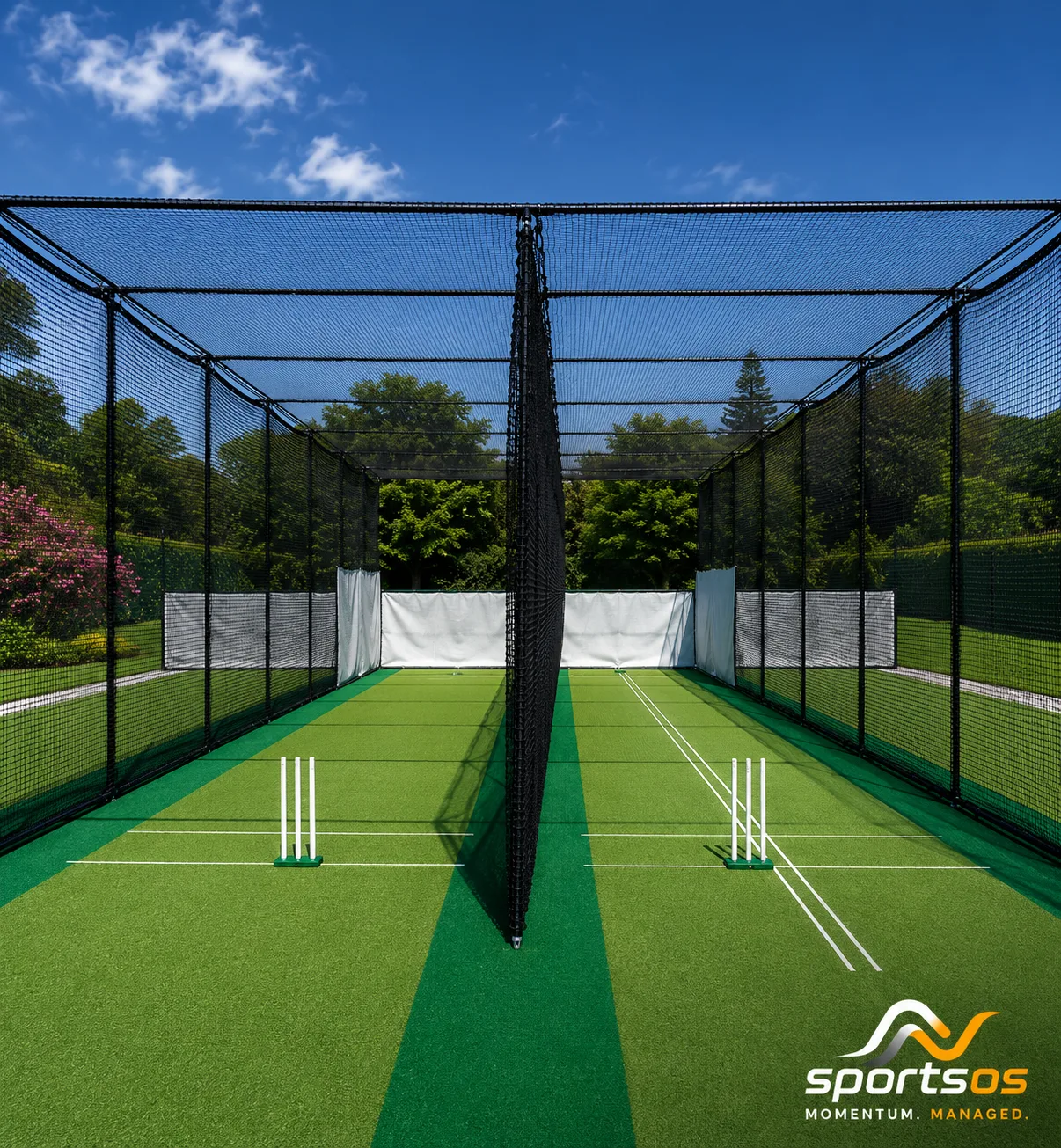
Box cricket cost is driven by five things: the enclosed area, the netting and frame structure, turf grade, the base under it, and floodlighting. Area and the enclosure structure account for most of the variation between quotes.
There is no regulated box cricket size. Boxes are built to the space available, which is why two quotes for "a box cricket setup" can describe completely different facilities.
There is no standard box size, and that matters
Box cricket is an informal format, so unlike a cricket pitch or a futsal court there is no governing dimension to work to. Boxes get built to whatever footprint a rooftop, plot or parking deck allows.
That makes the first question different from other sports. Instead of asking whether the site fits a standard, you decide what format the space supports, then build to it. A longer, narrower box plays as a batting and bowling contest. A squarer box plays as a scoring game where the walls are constantly in use.
What a box cricket quote is made of
| Line item | What drives it | Where quotes go vague |
|---|---|---|
| Enclosed area | Footprint in square feet, and the height of the enclosure | Height understated, so balls clear the net |
| Netting and frame | Steel section, galvanising, net grade and UV treatment | "Heavy duty netting" with no grade stated |
| Turf | Pile height, infill type, backing and UV stability | Quoted by area only, with no pile specification |
| Base | Slab condition, levelling, drainage, any shockpad | Excluded, then billed as a variation |
| Floodlighting | Lux level, pole count and positioning | Omitted, then retrofitted at higher cost |
Enclosure height is the specification people get wrong
Box cricket is played with the walls and roof net in constant use. If the enclosure is too low, balls clear it repeatedly, which stops play, annoys whoever is below or beside the box, and on a rooftop becomes a genuine safety issue rather than an inconvenience.
Height is also the hardest thing to change afterwards, because it means re-engineering the frame rather than replacing a panel. It deserves more attention at quoting stage than it usually gets.
Have a rooftop or plot in mind?
Send us the footprint and we will tell you what format it supports and what the enclosure needs to be, before you take quotes.
Turf specification, not just turf area
Turf is usually quoted by the square foot, which tells you nothing about what is being laid. Pile height affects ball behaviour and player comfort, infill affects both bounce and how the surface holds up, and UV stability determines whether the colour and fibre survive Indian sun.
Around 40 mm pile is the common working figure for football-style use on these surfaces. For box cricket the choice interacts with how much the surface is expected to take, since a box in continuous evening use wears far faster than a corporate facility used twice a week.
The base underneath
Turf follows the base exactly. On a rooftop the questions are load capacity, existing waterproofing and drainage falls. On a ground-level plot they are compaction, levelling and where water goes. Either way, base work is the item most likely to appear later as a variation if it was not properly scoped at the start.
On rooftops specifically, confirm structural load capacity before anything else. It is the one constraint that can stop a project outright, and it is cheapest to discover first.
Floodlighting belongs in the original scope
Box cricket is overwhelmingly an evening format. A box without floodlights is a facility that works for a few hours a day, which changes its entire economics whether it is corporate or commercial.
Adding lighting after the turf is laid means disturbing completed work and running cable through a finished surface. Include it from the start, and confirm fitting positions relative to the net so fittings are not struck.
Corporate box cricket versus commercial
A corporate box on a campus is sized for internal use in known windows, and utilisation is measured in participation rather than revenue. A commercial box is a revenue asset where cost per playing hour is the number that matters, which justifies heavier specification because the surface takes far more use.
Specifying a commercial box to corporate standards produces something that wears out early. Specifying a corporate box to commercial standards spends money the usage does not require. Establish which one is being built before comparing any quotes.
Comparing quotes
- Enclosed footprint and enclosure height, both stated
- Frame steel section and galvanising specification
- Net grade, mesh and UV treatment
- Turf pile height, infill and backing
- Base preparation, included or explicitly excluded
- Floodlighting, included or explicitly excluded
sportsOS does not publish box cricket prices, because footprint, base condition and site access change the figure so much that a number given without a survey is meaningless. What we will give you is a written scope against those six lines, which is what makes any set of quotes comparable.
Related cricket guides
- Cricket practice net cost, what drives a nets budget
- Cricket net dimensions, bay sizing and run-up
- Football turf, pile height, infill and base
- Cricket setup and installation
Frequently asked questions
What is the cost of a box cricket setup?
It depends on enclosed area, enclosure height, frame and net specification, turf grade, base preparation and floodlighting. Area and enclosure structure account for most of the variation between quotes.
What size should a box cricket area be?
There is no regulated size. Boxes are built to the available footprint. A longer narrower box plays as a batting and bowling contest, a squarer box plays as a scoring game with constant wall use.
How high should box cricket netting be?
High enough that balls do not clear it in normal play. Height is the hardest thing to change later because it means re-engineering the frame, and on rooftops a low enclosure is a safety issue rather than an inconvenience.
What turf is used for box cricket?
Artificial turf specified by pile height, infill and UV stability rather than by area alone. Around 40 mm pile is a common working figure, adjusted for how heavily the box will be used.
Can box cricket be built on a rooftop?
Often yes, but structural load capacity, existing waterproofing and drainage falls must be confirmed first. Load capacity is the constraint that can stop a project outright.
Planning a box cricket facility?
sportsOS surveys the footprint and base condition first, then scopes enclosure, turf, netting and floodlighting as one written specification.
See Cricket Setup →