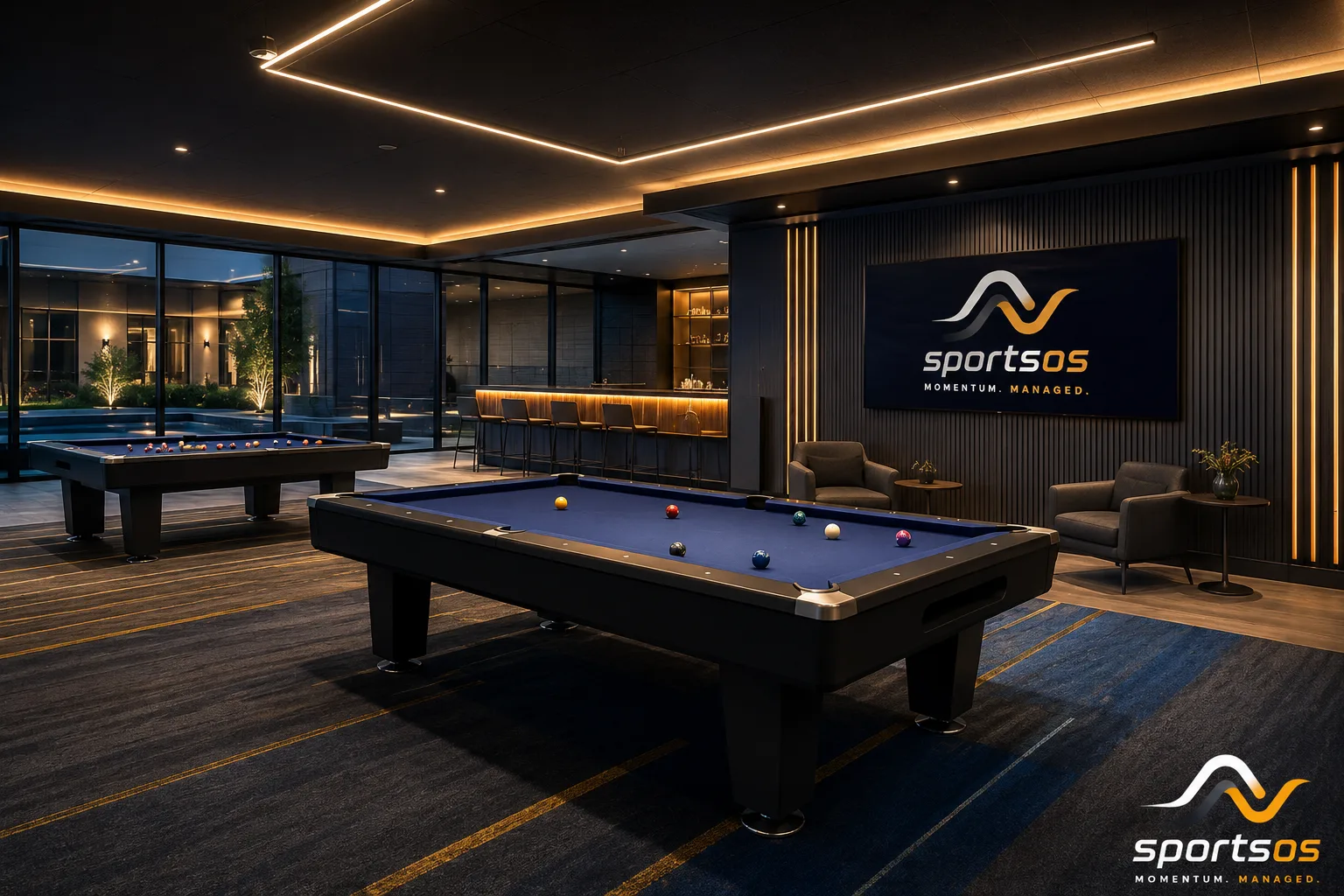
The table size is the easy part. The number that decides whether a room works is the clearance around it, because a cue needs room behind the ball.
The working rule: room size equals the playing surface plus, on every side, the cue length plus a short stroke allowance. With a standard 58 inch cue that adds roughly 5 ft 4 in to each side, or about 10 ft 8 in to each dimension overall.
Table sizes and the room each needs
The figures below apply that rule to the common table sizes, using a 58 inch cue with a 6 inch stroke allowance. They are the minimum for comfortable play on every shot, not the absolute minimum to fit a table in a room.
| Table | Playing surface | Room needed (ft) | Room needed (m) |
|---|---|---|---|
| 7 ft pool | 78 × 39 in | 17 ft 2 in × 13 ft 11 in | 5.23 × 4.24 m |
| 8 ft pool | 88 × 44 in | 18 ft 0 in × 14 ft 4 in | 5.49 × 4.37 m |
| 9 ft pool | 100 × 50 in | 19 ft 0 in × 14 ft 10 in | 5.79 × 4.52 m |
| 12 ft snooker | 140 × 70 in | 22 ft 4 in × 16 ft 6 in | 6.81 × 5.03 m |
A full size snooker table needs a genuinely large room, and this is the single most common reason a snooker order gets downgraded to a smaller table after the site visit. It is better to know before ordering than after delivery.
What to do when the room is tight
If the room cannot take full clearance on every side, the usual compromise is a shorter cue for the tight side rather than a smaller table. A short rest cue handles shots against a wall, and most recreation rooms operate this way quite happily.
What does not work is placing a table where one long side has almost no clearance. Shots along that rail become impossible rather than awkward, and a table people cannot play properly stops getting used.
Not sure your room takes the table you want?
Send us the room dimensions and we will tell you which table size fits with proper cue clearance, before anything is ordered.
Slate bed, and why it matters
The playing bed is what separates a table that plays true from one that does not. Slate stays flat over time in a way composite beds do not, and thickness affects both roll consistency and how well the table holds its level. A one inch slate bed is the usual specification for a table expected to see real use.
A composite or MDF bed is cheaper and is fine for very light domestic use. In a corporate recreation room, where a table may be in use for hours a day, it will develop roll problems, and the cost saving disappears the first time the table needs replacing.
Cloth
Cloth choice affects speed and durability. Napped cloth is traditional for snooker and plays slower with a directional grain. Worsted cloth is faster, more durable and the usual choice for pool tables in continuous use. In a corporate setting, durability generally matters more than tradition, because the table will see a wide range of players and no small amount of careless handling.
Lighting is part of the table, not the room
A pool or snooker table needs dedicated lighting directly over it, not ambient ceiling light. Without it, players cast shadows across the bed from wherever they stand.
Pendant fixtures should run the length of the table and sit high enough that a raised cue does not strike them, but low enough to light the bed evenly with no bright centre and dark ends. A single central pendant over a full size table produces exactly the wrong result.
Floor and levelling
A slate table must be levelled on installation and re-levelled if it is moved. The floor needs to be sound enough to hold that level, since a slate bed on a floor that flexes will drift out of true. Carpet over a solid floor is fine. A raised access floor needs checking before delivery, because these tables are heavy and the load is concentrated on the legs.
Before ordering
- Room dimensions measured, including door swing, columns and any furniture staying in the room
- Whether full cue clearance is available on all four sides, or a short rest is needed on one
- Slate bed thickness, stated in the quote
- Cloth type matched to expected usage rather than tradition
- Dedicated pendant lighting along the table length
- Floor load capacity and access route for delivery
Related recreation guides
- Billiards and pool table setup, full supply and installation
- Table tennis table size, ITTF dimensions and room space
- Office game room setup, planning a multi-activity room
- Multi-sport campus space planning
Frequently asked questions
What size room do I need for a pool table?
Playing surface plus cue length and a stroke allowance on every side. With a 58 inch cue that means roughly 17 ft 2 in by 13 ft 11 in for a 7 ft table and 19 ft by 14 ft 10 in for a 9 ft table.
How much room does a full size snooker table need?
A 12 ft snooker table with a 140 by 70 inch playing surface needs about 22 ft 4 in by 16 ft 6 in, or 6.81 by 5.03 m, for full cue clearance on all sides.
What if my room is slightly too small?
Use a short rest cue for the tight side rather than dropping to a smaller table. What does not work is a table with almost no clearance along a full long rail, since shots along it become impossible.
Why does slate thickness matter?
Slate stays flat over time where composite beds do not, and thickness affects roll consistency and how well the table holds level. A one inch bed is the usual specification for a table in real use.
What lighting does a pool table need?
Dedicated pendant lighting running the length of the table, high enough to clear a raised cue and positioned to light the bed evenly. Ambient ceiling light alone causes players to shadow the bed.
Adding a pool or snooker table?
sportsOS supplies and installs pool, snooker and billiards tables, levels them on site and handles the lighting so the room plays properly.
See Billiards & Pool Setup →