The court that commands the room, and fills it every session.
FIBA-standard basketball courts built for corporate campuses. Maple hardwood, premium vinyl, or outdoor acrylic, installed in 7–12 days, complete with hoops, line marking, and wall protection.
Choose your court surface
From premium maple hardwood for indoor arenas to UV-stable acrylic for outdoor courts, we match the surface to your space and budget.
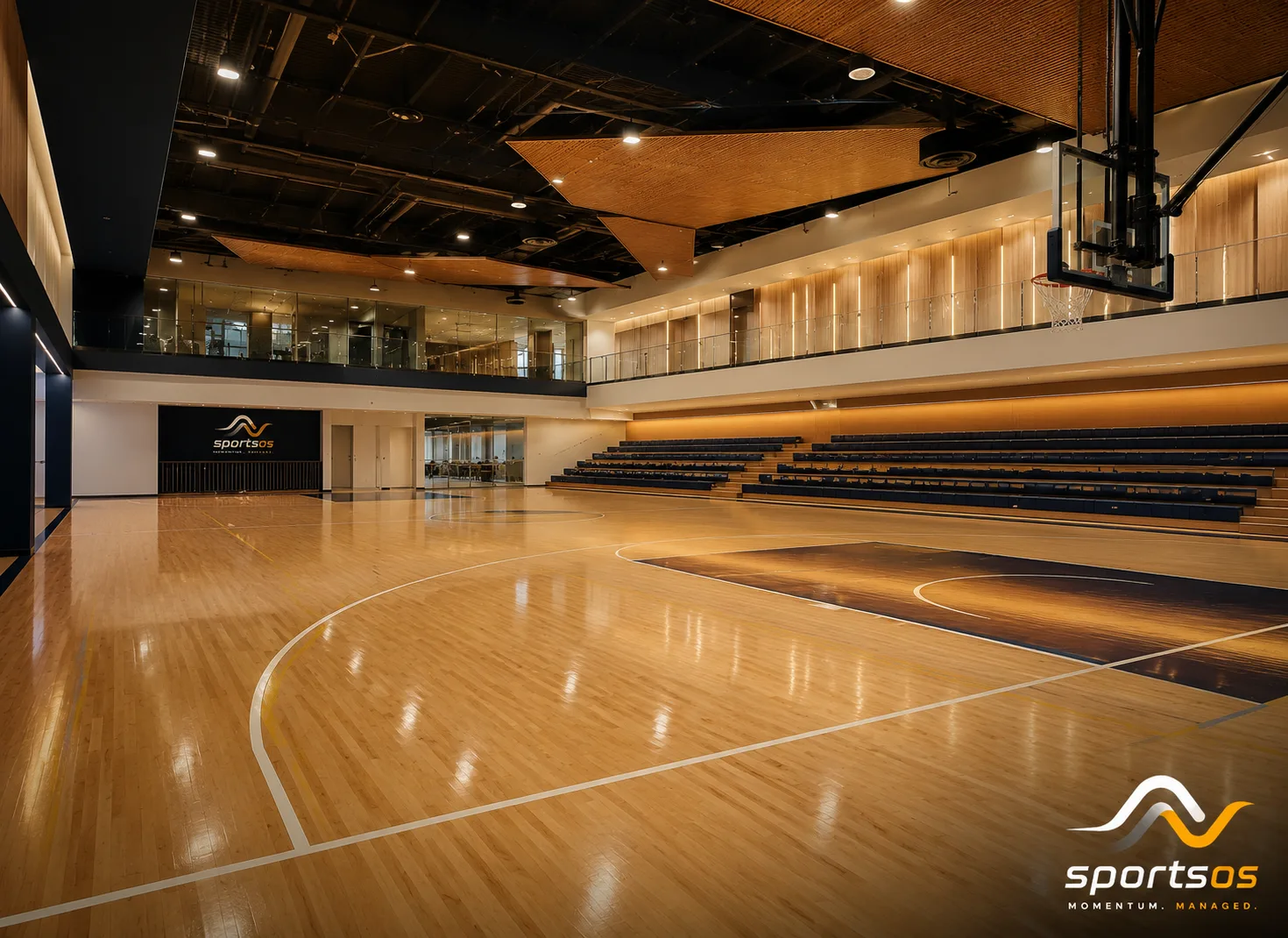
Maple Hardwood Court
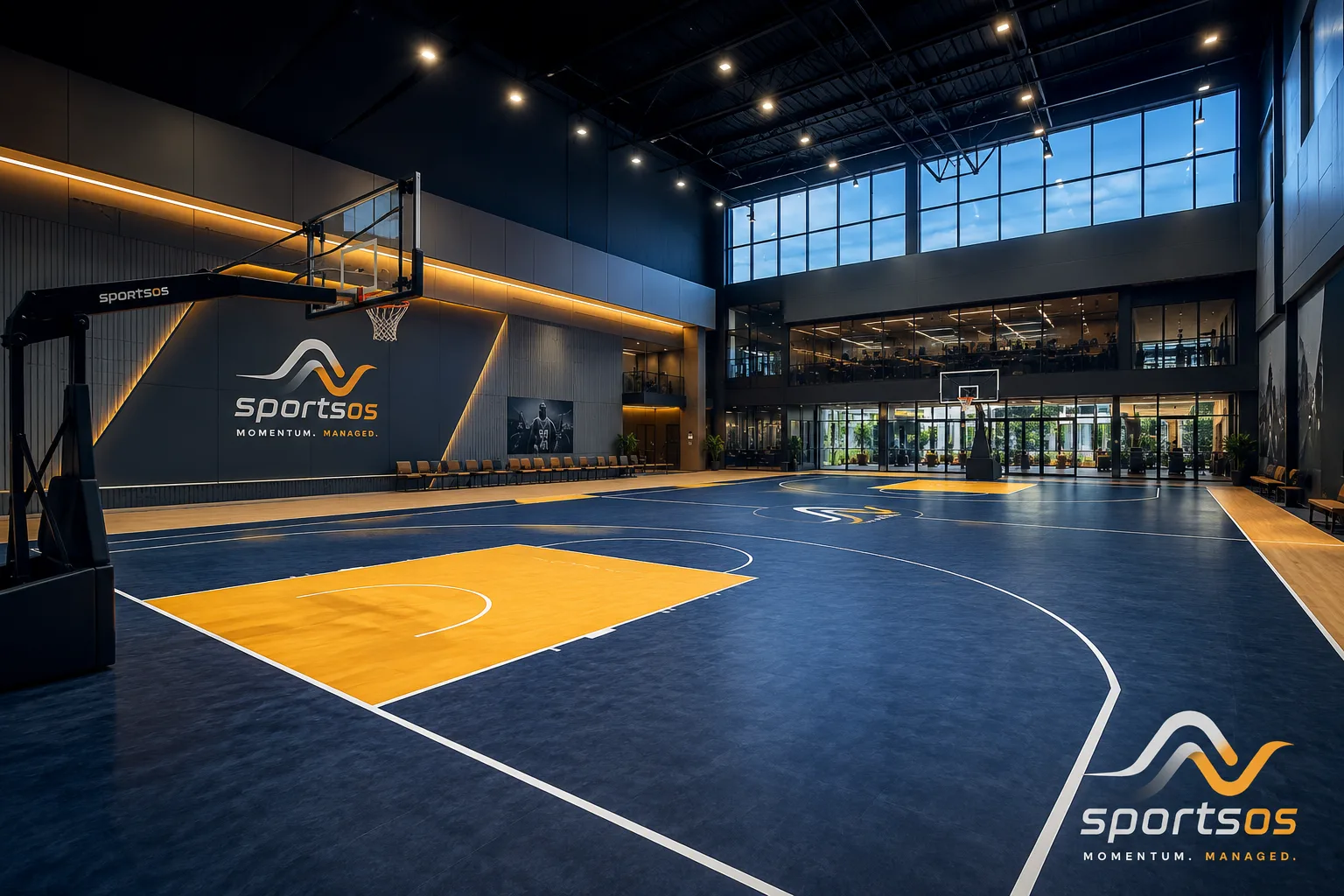
Acrylic Hard Court
Everything in one project
From sub-base preparation to the final buzzer, sportsOS handles the complete build so your facilities team doesn't have to coordinate five vendors.
Sports Flooring System
Maple hardwood with sprung sub-floor or 8 mm sports vinyl, both certified to EN 14904 for shock absorption and ball rebound.
Backboards & Hoops
Tempered glass or acrylic backboards (1.83 m × 1.07 m), breakaway rims, and net sets. Fixed fan-shape and rectangular options available.
Court Line Marking
Full FIBA markings: 3-point arc, key/paint area, free throw lane, centre circle, restricted area arc, routed or painted to regulation dimensions.
Wall Padding & Safety
High-density foam panels behind backboards and on side walls within 2 m of the court. Reduces injury risk and meets facility safety standards.
LED Court Lighting
High-output LED arrays calibrated to ≥ 750 lux for competitive indoor play. Uniform illumination eliminates shadows across the full court surface.
Handover & Training
Floor care guide, maintenance schedule, and on-site walk-through with your facilities team. 1-year defects warranty as standard.
Built to FIBA standard
| Specification | Value |
|---|---|
| Full court (FIBA) | 28 m × 15 m |
| Full court (NBA) | 28.65 m × 15.24 m |
| 3×3 mini court | 15 m × 11 m |
| 3-point line distance | 6.75 m (FIBA) |
| Key / paint dimensions | 4.9 m wide × 5.8 m long |
| Hoop height | 3.05 m |
| Indoor floor (maple) | 22 mm tongue-and-groove |
| Indoor floor (vinyl) | 8 mm sports vinyl |
| Shock absorption | Class A (EN 14904) |
| Lighting (competitive) | ≥ 750 lux |
| Structural warranty | 5 years |
Basketball Court Layout, FIBA 28 m × 15 m
Right-size your court
Not every campus has a full arena footprint. We offer three configurations so you get the best court for your available space.
3×3 Mini Court
15 m × 11 m footprint with two hoops. FIBA 3×3 compliant, perfect for smaller terraces or rooftop spaces.
- Two hoops (fixed or foldable)
- Acrylic or vinyl surface
- 3×3 line marking
- Fits tight spaces
Full Basketball Court
FIBA-standard 28 m × 15 m with maple hardwood, full line marking, glass backboards, and LED lighting.
- Maple hardwood or sports vinyl
- Full FIBA line marking
- Glass backboards & breakaway rims
- 750+ lux LED lighting
Half-Court Practice
28 m × 7.5 m half-court setup, ideal for employee skill sessions, shooting practice, and smaller budgets.
- Single basket system
- Half-court line marking
- Sports vinyl flooring
- Ideal for skill training
From blueprint to tip-off in 4 steps
Site Survey & Planning
Our team visits your campus to assess floor area, ceiling height, structural load, and lighting conditions.
Court Design & Approval
We prepare a scaled layout with court markings, equipment placement, and material specifications for your sign-off.
Flooring & Equipment Install
Sub-floor prep, flooring installation, hoop assembly, line marking, and LED lighting, all in one coordinated crew.
Handover & Warranty
Floor care guide, maintenance schedule, and a full defects inspection before we hand the court over to your team.
Common questions
Maple hardwood is the gold standard for indoor basketball flooring, offering certified shock absorption to Class A of EN 14904 and a verified ball rebound rate of 94% or higher, both critical for consistent dribbling and player safety across the full court. Maple's natural springiness also reduces joint stress during extended play, which matters in a corporate environment where players may be recreationally active but not professionally conditioned. For budget-conscious projects, 8 mm sports PVC vinyl is an excellent alternative: it meets Class B EN 14904 shock absorption requirements, is significantly less expensive per square metre than maple, and handles the moderate traffic of corporate use reliably. Vinyl installs faster, is easier to maintain, and does not require recoating. The trade-off is a harder, less forgiving playing surface for intensive daily play. sportsOS will recommend the right flooring based on your usage intensity, budget, and the primary sports the space will support.
Yes, sportsOS regularly installs basketball setups in campus spaces that cannot accommodate a full-size FIBA regulation court (28 m × 15 m). A FIBA 3×3 court requires only 15 m × 11 m (roughly equivalent to two standard parking bays), and is specifically designed for structured competitive play in a compact footprint. A half-court layout (14 m × 15 m) is another practical option for corporate settings, supporting shooting drills, 2-on-2 games, and practice without requiring a full-court run. For very tight spaces, a single-hoop shooting zone with a marked free-throw line and three-point arc gives employees a usable basketball facility in as little as 8 m × 9 m. sportsOS designs every layout to maximise available dimensions, specifying basket height, backboard type, and floor markings to match the court format. Our design team will propose the best configuration for your specific floor plan at no charge during the site assessment.
sportsOS supplies both fixed and portable basketball hoop systems, and the right choice depends on how your space will be used. Fixed systems (wall-mounted cantilever arms or ceiling-hung units) are the correct specification for any permanent court where basketball is played as the primary sport. Fixed systems accept glass or acrylic backboards, offer the most stable rebound surface, and are typically installed with height-adjustment mechanisms that comply with FIBA junior and standard specifications. Portable freestanding hoop units are better suited to multi-purpose halls where the basketball setup needs to be cleared for other activities such as events, yoga, or badminton. They can be wheeled into position and locked in place before play. The trade-off is stability: portable bases weighted with sand or water provide reasonable stability for casual play but are not suitable for aggressive dunking or high-intensity training. We carry glass backboard systems for fixed installations and acrylic for portables.
FIBA guidelines specify a minimum horizontal illuminance of 750 lux for Level I competitive play, measured at floor level with a 0.7 uniformity ratio, meaning the darkest point of the court should be no less than 70% of the average illuminance. For training and recreational campus courts, 500 lux with 0.6 uniformity is considered adequate. Poorly designed lighting systems with inconsistent coverage create shadowed zones near the backboards and corners, which affects shooting accuracy and increases ball-tracking difficulty during fast play. sportsOS designs LED high-bay arrays positioned to deliver both target illuminance and high uniformity across the entire playing surface, including the area directly beneath each basket, a commonly neglected zone. Every lighting installation we complete includes a post-installation lux measurement certificate covering a minimum nine-point measurement grid, confirming compliance before the facility is handed over. LED systems we specify also deliver 80+ CRI, ensuring true colour rendering for line visibility and game recording.
Maintaining a maple hardwood basketball court correctly is critical to preserving both appearance and performance. The daily routine is dust mopping with a treated microfibre mop to remove dust, sand, and grit, abrasive particles are the primary cause of finish wear, and daily mopping prevents them from accumulating on the surface. Weekly damp mopping with a pH-neutral sports floor cleaner removes embedded oils and sweat residue. Avoid wet mopping or steam cleaning, which causes wood to swell and can lift the polyurethane finish. Footwear policy is non-negotiable: the court must be used exclusively with non-marking rubber-soled sports shoes, outdoor or street shoes damage the surface immediately. Heavy equipment should never be dragged across the floor; use rubber castor mats for any rolling loads. The polyurethane finish requires a full recoat every two to three years depending on use intensity. With consistent care, a maple hardwood floor reliably lasts 20–30 years.
Ready to build your basketball court?
Get a site visit and detailed quote within 48 hours. No commitment required.